

 |
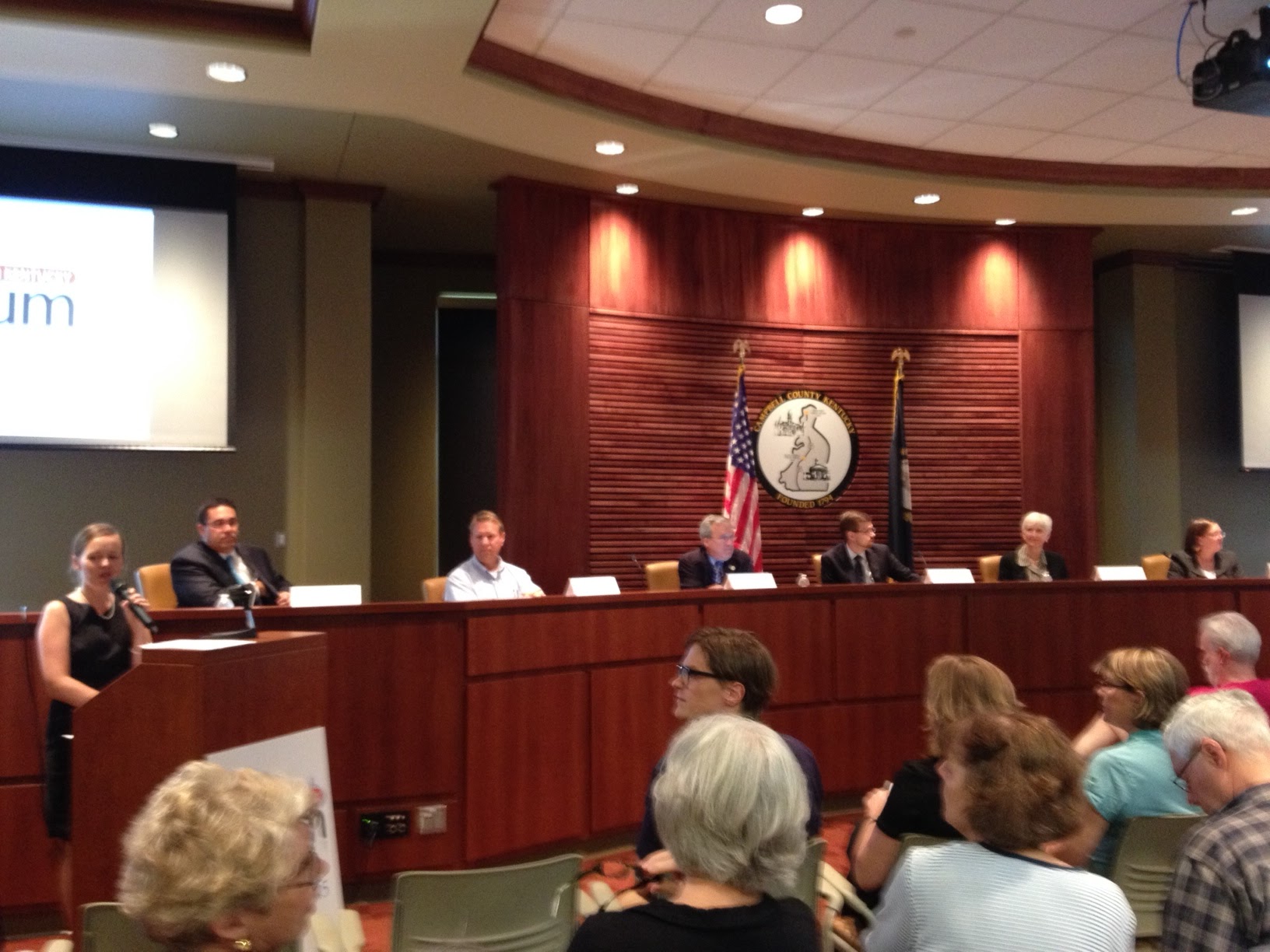
| NKY Forum convened at Campbell County Fiscal Court Chambers |
“The world of taxing districts is… confusing.”
Andrew Hartley, former staff attorney for the Kentucky Department for Local Government and current city attorney for Georgetown, opened his remarks with these words Wednesday night, during NKY Forum’s first event of the 2013 season, “Are Public Libraries Still Valid in the 21st Century.”
The panel convened to discuss various issues surrounding the state of northern Kentucky’s public library systems, including a lawsuit filed earlier this year, charging that the Campbell County Public Library (CCPL) has been illegally increasing tax revenues for the past three decades.
The legal dispute arose from disagreement over which piece of KY legislation CCPL is bound to follow, House Bill 44 or KRS 173.790. Both statutes separately determine how library systems can increase tax rates.
Along with Mr. Hartley, the panel included Erik Hermes, a resident of Cold Spring and business owner, and also the plaintiff in the lawsuit. Also present on the panel were Brandon Voelker (attorney for the plaintiff), Jeff Mando (attorney for CCPL), Kim Fender (Director of the Public Library of Cincinnati & Hamilton Co.), Barbara Stripling (President of the American Library Association), and Jim Waters (President of the Bluegrass Institute for Public Policy Solutions).
The panel was moderated by Channel 12’s morning anchor, John Lomax.
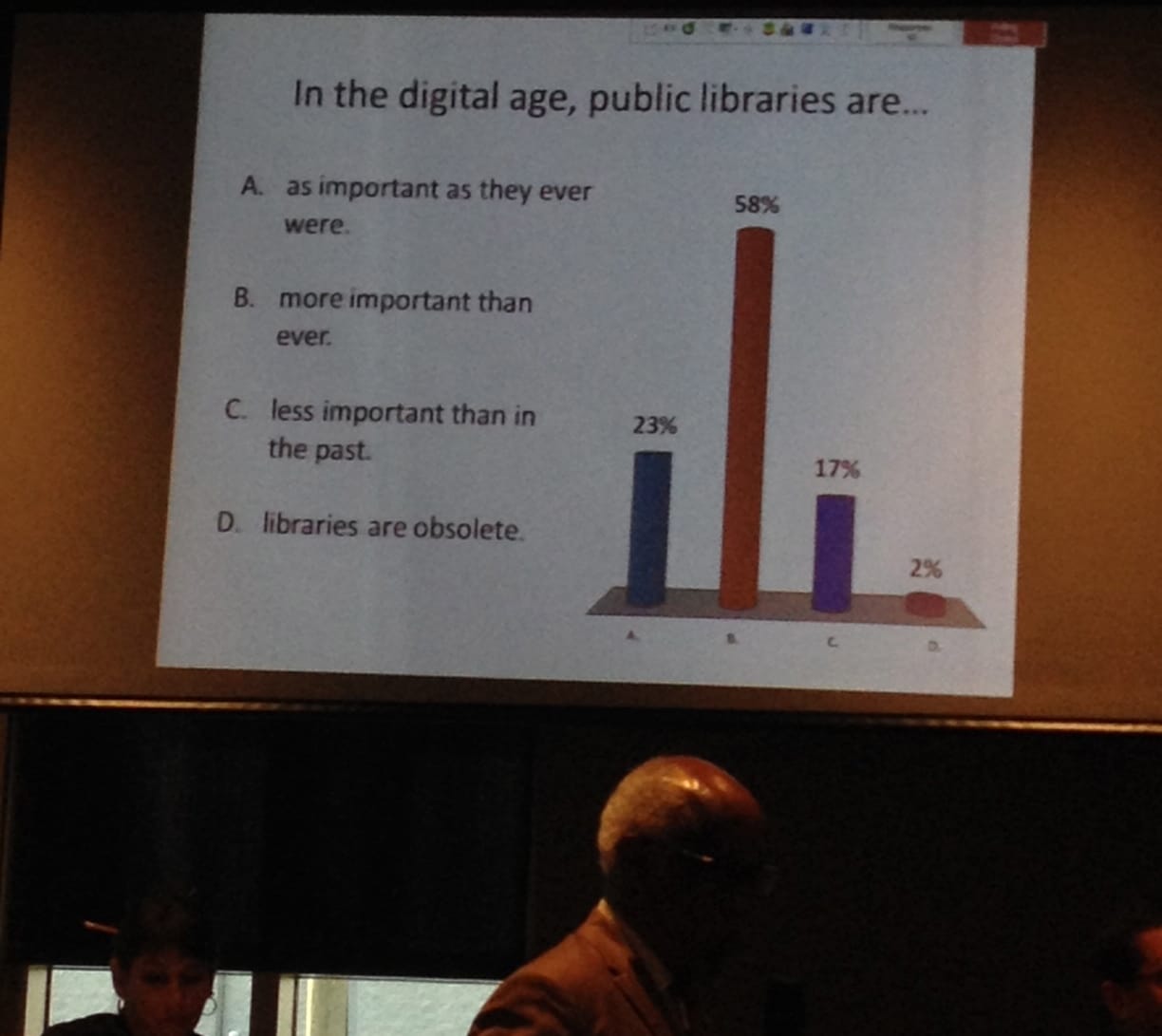 |
| NKY Forum used real-time audience polling to fuel panel discussion. |
The discussion followed a relatively straightforward format — Mr. Lomax asked each panelist a predetermined question, with subsequent discussion — but NKY Forum also threw in a little twist: real time audience polling, using remote controls through which audience members could submit answers to questions posed throughout the panelist’s discussion. The final half hour of the discussion was opened up to audience questions.
Despite posing a very general question as its topic, it became clear quickly that the main topic of discussion would be the pending lawsuit against CCPL. It also became immediately clear that the panel was evenly divided regarding their opinions of the lawsuit.
If upheld, the lawsuit — currently awaiting trial in the Kentucky Court of Appeals — would roll funding levels back to mid-1980s levels, over a 60% decrease.
Competing Stories
The panel’s division became clear in the stories each side was trying to tell. Hermes and Voelker, the plaintiffs in the pending case, argue that the issue is not with the libraries in general. “This case is purely about establishing the correct method of raising the tax rate,” said Mr. Hermes.
Mr. Waters chimed in, asking: “Does a vote against a tax increase really mean that voter does not find libraries valuable? No.”
Repeatedly referencing “the voice of the people” as the appropriate source for tax increases, Voelker and Hermes insisted that, per KRS 173.790, rate hikes for public libraries should only be enacted by a petition signed by 51% of voters.
Mr. Mando interjected, though, insisting that CCPL — along with 78 other library districts in the state — has been following HB 44 for the last three decades, with no pushback from the KY General Assembly or any other legislative or bureaucratic body.
Law Enforcement vs. Impact
Mando was also quick to turn the discussion to the dramatic impact on CCPL’s funding that will result should the current ruling withstand the appeal, pointing out that there are 78 other counties in Kentucky whose libraries would face the same fate should this ruling become precedent.
Ms. Fender chimed in, explaining that a funding cut of this size would be “detrimental” to the scope of services offered by her library. “Funding uncertainty,” she explained, “makes any sort of long-term planning very difficult.” Services at each branch would certainly decrease, and it is possible one of Campbell County’s branches would close as a result of the funding rollback.
Dr. Stripling also added, “Libraries are a public service agency. We need to get to the substance of this issue,” in an attempt to highlight what she and others argue is the loss Campbell County will incur should the ruling be upheld.
All in all, Mr. Hartley’s initial comments were probably more true than he anticipated. It’s one thing to note the especially complex bundle of legislation to which our libraries are bound to adhere.
But it’s another thing to see the competing narratives of this debate play out before your very eyes.
At least one thing seems clear, as Mr. Mando pointed out: “I envision this case will go to the KY Supreme Court.”
If you missed the forum, the discussion continues on NKY Forum’s Facebook page.
