


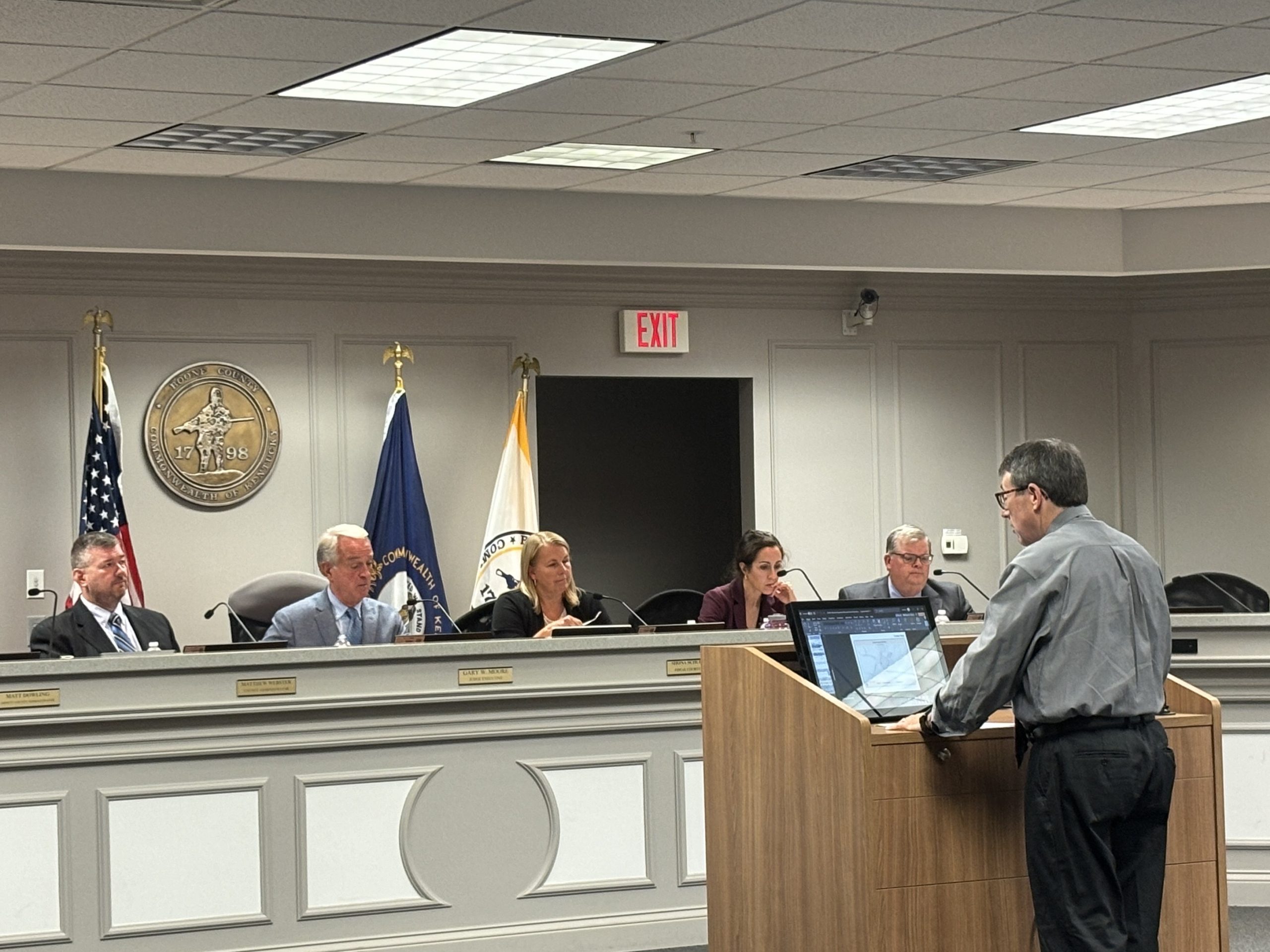
- Boone County discussed whether to adopt an alternative zoning map amendment process.
- This would effectively shorten the zoning map amendment approval window from 90 days to 21.
- An ensuing discussion focused on efficiency versus public input.
Boone County is considering reducing the timeframe for approving zoning map amendments.
At a previous fiscal court meeting on May 13, the legislative body asked county staff to review the “alternative zoning map amendment” process. The process is outlined in Kentucky law under the Kentucky Regulatory Statutes.
The statute outlines a streamlined process for zoning map amendments in Kentucky, where the Planning Commission’s recommendation becomes final unless actions are taken within 21 days.
During a meeting on Aug. 5, the fiscal court discussed whether to consider adopting an alternative zoning map amendment process. The fiscal court took no legislative action, using the time solely for discussion on the issue.
Boone County Judge/Executive Gary Moore said the reason the fiscal court was exploring shortening the timeline was to “streamline the process.”
“It’s a way to streamline the process and get government out of the way and let the process happen, unless there is a need for the full process to kick in,” Moore said.
The Boone County Planning Commission’s usual zoning map amendment process starts when a property owner or developer submits an application. Applicants provide the necessary forms, fees, drawings and often a suggested concept development plan, which staff review for completeness in accordance with state law.
A public hearing is then conducted to collect input, followed by the commission issuing a recommendation to approve, approve with conditions, or deny the request. Once the planning commission issues a recommendation, the fiscal court has 90 days to legislatively act. The fiscal court makes the final decision.
Boone County Zoning Administrator Michael Schwartz explained the rationale behind potentially shortening the alternative zoning map amendment process.
“What alternative regulations do is compress that 90 days down to 21,” Schwartz said. “It basically says that unless an agreed party files a notice with the planning commission saying that they want the full legislative body to take final action, if that doesn’t happen within 21 days of the planning commission’s recommendation, the recommendation of the planning commission becomes final and effective.”
Essentially, amending the zoning map through the alternative process shortens the approval timeline by about 70 days. The process is generally used for non-controversial projects.
If an applicant wants to undertake the full-length approval process, a notice must be filed with the planning commission. Any notification, such as an email or letter, is valid.
Furthermore, Schwartz mentioned that the approval process for traditional zoning map amendments would remain the same despite the prospective shortening of the alternative process.
If changed, zoning map amendments, concept development plans, and changes to concept development plans would be subject to the shortened timeline. The changes would not apply to text amendments.
Commissioner Chet Hand expressed concern that some residents might not be aware they need to respond within the 21-day period, which could cause them to miss the opportunity to engage in the standard public input process.
“The concern that I’m thinking about here is sometimes people don’t really get engaged on this stuff until it comes down to the wire, either they don’t know about it or its just not a priority until its right then and its time, so I’m concerned about somebody not knowing they need to file something within that 21 day period, and then the normal process doesn’t play out, and then they don’t get to provide feedback the way they normally would like to,” Hand said.
Schwartz responded by presuming that the planning commission would implement a policy where the chair announces that, unless a notice is filed, the action will automatically become final and effective after 21 days.
Boone County Administrator Matthew Webster compared the process to the fiscal court’s consent agenda procedure.
“This is very similar to our (fiscal court) consent agenda process,” he said. “Any of you (commissioners) can decide if the court’s going to hear it by providing notice through whatever process we create.”
Later in the discussion, Hand reiterated his concern about shortening the window.
“One of my concerns is that the main purpose of that whole 90-day timeline is to provide maximum opportunity for the people to come in and provide feedback during the first reading, during the second reading–we have the opportunity to have our own public hearing, it’s to provide relief to the public,” he said.
Commissioner Cathy Flaig asked Schwartz whether the potential change could possibly help applicants save money during the process. Boone County Attorney Jordan Dallas Turner mentioned that reducing the window could benefit applicants by preventing them from having to bill their attorneys for multiple meetings.
While concluding the discussion, Webster said he would give the fiscal court “a few weeks” to digest the issue before potentially reintroducing it as an Old Business item during an upcoming meeting. If the fiscal court finds the measure worthwhile, it could then instruct the planning commission to carry out the full recommendation process.
Hand suggested that the fiscal court should possibly hold a caucus meeting to encourage more public involvement.
